Back
Back


The US healthcare industry is an economic contradiction. It is a $4.9 trillion behemoth consuming nearly 20% of the national GDP, yet it remains a “digital laggard” where nearly $1 trillion is annually devoured by administrative waste – money that disappears into the friction of claims, billing, and reconciliation and never touches a patient.
However, the “slow to change” narrative was shattered in 2025. Data from Menlo Ventures’ 2025 report shows healthcare adopting AI 2.2x faster than the broader economy. The industry is finally treating its administrative burden as a data-orchestration problem. We are seeing a fundamental shift where “services dollars” (the high cost of manual human labor in billing departments) are being converted into “software dollars” (autonomous agents driving back-office orchestration). This isn’t just a clinical upgrade; it is a financial re-architecture.
Vertical Fintech: Context as a Moat
Viola Fintech’s core investment thesis in 2026 is focused on vertical fintech. Earlier generations of Fintechs have given us horizontal solutions. These platforms have reached significant scale as they attempted to serve a broad common denominator. We believe that the current wave of Fintech innovation is all about depth and expertise. Vertical solutions are being built around the unique DNA of a specific industry, leveraging proprietary data and meta-data and trusted distribution channels that create high defensibiity.
More than anything, this is a shift in how we value context. The context layer enables companies to move from providing platforms that show information to delivering agents that can make critical decisions in real-time.
Healthcare + Fintech = ❤️
Healthcare Fintech is one of the most profound applications of this verticalized approach; It is the intersection where clinical data meets financial flow. There are five driving forces that make this niche particularly interesting right now.
1. Regulatory Tailwinds: Increased price transparency laws and interoperability mandates (like FHIR standards) are finally unlocking the data silos.
2. The Shift to Value-Based Care: Moving from “fee-for-service” to “outcomes-based” models requires sophisticated financial engineering and risk-sharing tools that old systems can’t handle.
3. The Margin Squeeze: With rising costs and labor shortages, providers can no longer afford the 3-4% “leakage” in their revenue cycles.
4. The “Consumerization” of the Patient Experience: In 2026, patients expect the same seamless payment flow, personalized financing options and enhanced transparency that they get in other consumer experiences.
5. The Workforce Crisis & Clinical Burnout: This is no longer just an efficiency play; it is a survival play. Clinical burnout is at an all-time high. By automating the crushing weight of financial paperwork, we can literally save the clinical workforce and allow doctors and nurses to stop being data-entry clerks and start being clinicians again.
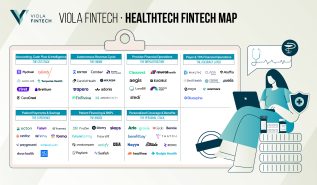
The Healthcare Fintech Map
We created the Healthcare Fintech startup map to better understand the building blocks of the Healthcare Fintech space.
Autonomous Revenue Cycle Management (The Engine)
Traditional RCM systems depend on hundreds of people in call centers manually checking portals and driving processes. Autonomous RCM solutions leverage AI to make decisions and perform the work independently, shifting humans from being ‘in-the-loop’ of every transaction to being ‘on-the-loop’ for high-value exceptions.
Camber is a standout for its sub-vertical focus on behavioral health. By mastering the specific denial logic of this high-volume sector, they strive to achieve cleaner claims and faster liquidity than any horizontal player.
Provider Financial Operations (The Infrastructure)
These are the mission-critical “pipes” that allow providers to communicate with the broader financial ecosystem, ensuring enhanced efficiency for these medical providers.
Stedi acts as the modern, programmable clearinghouse. It replaces the “black box” of legacy EDI with developer-friendly APIs, effectively becoming the “Stripe for Healthcare.”
Clearest focuses on transparency, ensuring that both providers and patients have clinical and financial clarity before care is delivered.
Payer & TPA Financial Operations (The Accuracy Layer)
This category is mostly about “Payment Integrity” – ensuring the trillions of dollars flowing through insurance companies are managed with precision. These tools allow payers to shift from a “pay and chase” model to one where accuracy is verified in real-time, drastically reducing overhead.
Rialtic is a critical platform for payment accuracy, allowing payers to catch errors before they pay, rather than chasing them months later.
Patient Payments & Savings (The Experience)
This category addresses the “last mile” of healthcare finance, turning a confusing medical bill into a manageable consumer transaction. These platforms are vital for maintaining patient trust and transparency, and ensuring that high out-of-pocket costs don’t lead to provider bad debt.
Ecton eradicates the fear of unexpected medical bills by shifting from reactive, event-based billing to long-term, personalized financial planning. By combining a savings wallet and HSA with proactive planning, they enable providers to build long-term patient engagement and loyalty, moving the relationship from a transactional “event” to a lifelong partnership.
Sheer Health is an AI-driven advocate that monitors claims for patients and automatically fights for reimbursements.
Patient Financing & BNPL (The Bridge)
As deductibles rise, the ability to finance care becomes a clinical necessity rather than just a financial perk. By using alternative data to underwrite patients, these companies expand access to care while de-risking the provider’s balance sheet.
PayZen uses AI to underwrite patient affordability, offering interest-free payment plans that ensure providers get paid upfront while patients have a dignified way to manage costs.
Accounting, Cash Flow & Intelligence (The CFO Stack)
This is the “CFO Stack” designed specifically for the unique complexities of medical accounting, such as accrual-based revenue and complex tax credits. It provides practice owners with a real-time “command center” to manage margins in an era of rising labor costs.
Flychain has built a financial control tower for SMB practices, offering unified bookkeeping and medical factoring to unlock capital from unpaid claims.
Personalized Health Coverage & Benefits (The Personal Stack)
This layer reimagines the insurance product itself, moving away from rigid, one-size-fits-all plans toward portable, employee-centric models. These platforms enable a “defined contribution” approach that gives employees more agency while providing employers with cost predictability.
By leveraging AI-driven insights, Nayya transforms the “open enrollment” headache into a personalized financial advisory session. They stand out by connecting the dots between clinical needs and financial wellness, ensuring employees make the most cost-effective decisions for their unique health situations.
Final Thoughts: The Road to “Invisible Healthcare”
The future of healthcare won’t look like a better billing department; it will look like invisible infrastructure – reliable pipes that make the financial complexity of healthcare simply disappear. We will likely see a shift toward Agent-to-Agent Negotiation, where payer and provider agents settle claims in milliseconds without any human intervention, increasing the revenue-per-employee significantly.
By embedding financial clarity directly into the clinical workflow, we are moving toward a world where the “price tag” is known upfront and the payment process is as seamless as an Uber ride. This isn’t just about efficiency; it’s about restoring trust. When we remove the opaqueness of healthcare finance, we allow the patient to focus on what actually matters: their health.
The Healthcare Fintech Map