


 Back
Back


Insurtech spent the last decade proving a painful point. Billions of dollars flowed into slick apps, better underwriting models, and direct-to-consumer brands promising to reinvent a centuries-old industry. A lot of that capital went to zero. And when you look closely at what separated the survivors from the casualties, the dividing line wasn’t the quality of the app or even the accuracy of the underwriting. It was something far less glamorous: who owned the customer, and who was trusted enough to be there when a claim actually hit.
This is the uncomfortable truth we keep coming back to at Viola Fintech. In insurance, the two things everyone obsesses over – capital and underwriting – are no longer where a new entrant builds its edge. The durable value is being created somewhere else entirely. To see where, it helps to look at insurance not as a product but as a stack.
The Insurance Value Stack
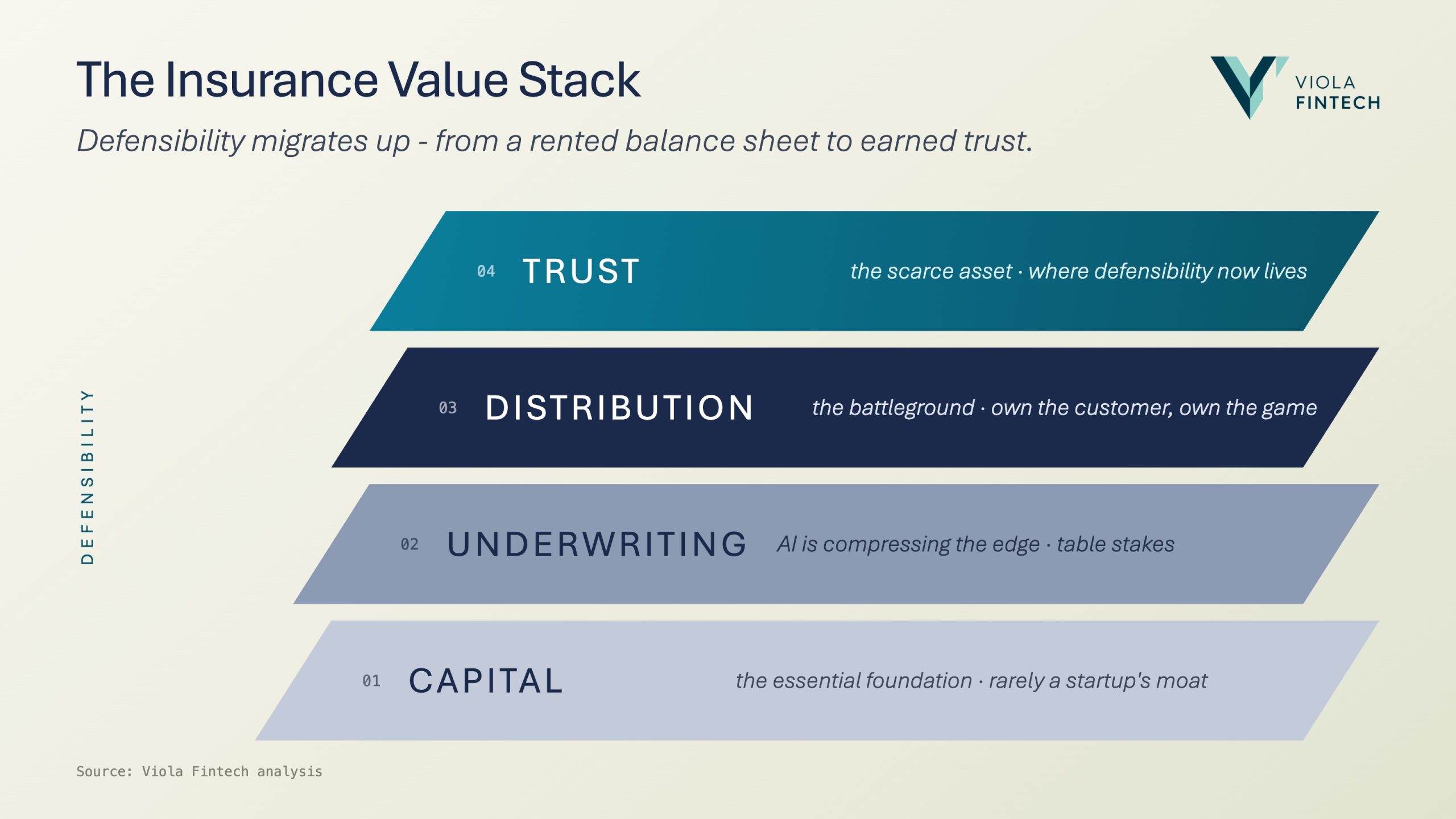
Picture the insurance business as four layers, stacked from bottom to top: Capital, Underwriting, Distribution, and Trust. Every insurance company is really an assembly of these four things. The critical shift we’re seeing – and the thesis behind how we invest in the space – is that defensibility is migrating up the stack. The bottom layers are essential, but nearly impossible for a startup to own. The top layers are where new entrants actually build a moat.
Start at the bottom:
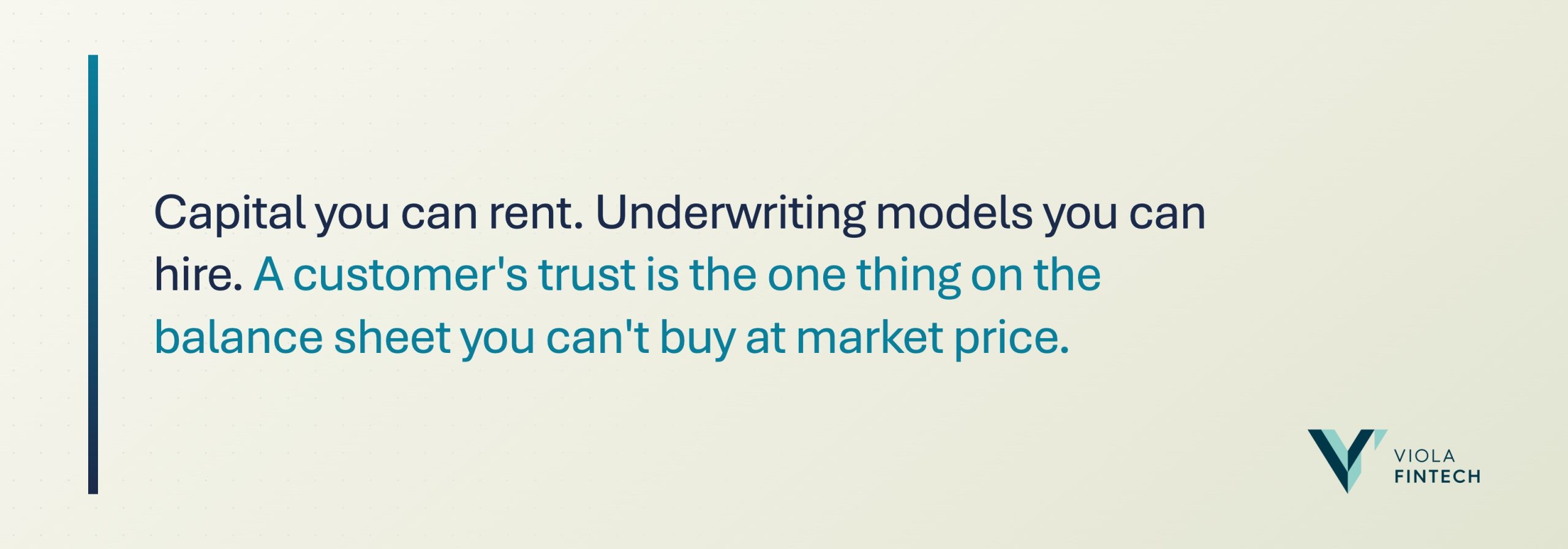
Capital is the foundation – the essence of insurance itself. A policy is a promise to pay for the unforeseen, and that promise is only ever as good as the balance sheet behind it. Far from being commoditized, capital is one of the highest barriers to entry in the entire industry: the regulatory capital, the ratings, the reinsurer relationships, and the track record required to hold real risk are precisely what keep most newcomers out. And that is the point. Because the barrier is so high, most insurtech startups never clear it on their own, they rent it, building on top of a carrier’s balance sheet they neither own nor control. That is a foundation someone else can pull out from under you. It’s exactly what the cyber-insurance startups are learning right now, as the large carriers decide cyber is a line they want to keep and withdraw the capacity they once lent out. The lesson isn’t that capital doesn’t matter – it’s that it matters so much, and is so hard to own, that renting it can be fatal. Capital is essential; but for a startup it is rarely a moat you build, and more often a dependency you have to manage. Your durable edge has to come from a layer you can actually own.
One layer up, Underwriting used to be the craft – the proprietary edge that justified the whole enterprise. But AI and data are compressing that edge fast. A great model today buys you a 12-to-18-month lead, not a moat. The exception, tellingly, is genuinely new risk – the emerging categories that are too new to have a settled price, where real underwriting edge still lives (more on that later). Everywhere else, sharp underwriting is becoming table stakes rather than a differentiator.
Which leaves the top of the stack. Distribution – owning the point of sale, the customer relationship, the moment of intent. And above even that, Trust. It’s worth being precise about what trust means in insurance, because customers actually reach for it twice. The first time is at the moment of purchase: is this the right coverage, and am I being offered a fair price – or something someone is simply incentivized to sell me? The second is at the moment of truth, the claim: when the worst happens, will they actually pay, quickly and without a fight? A company that earns trust at both moments owns the scarce asset. This is where retention, lifetime value, and real pricing power now live.
The Only Question That Matters
If the value is at the top of the stack, then the job of an investor is simple to state and hard to answer: find the companies that own it. We’ve found the cleanest way to do this is to plot every company on two axes – do they own the customer or rent them, and have they earned real trust or not. The companies that rent their customers and were never trusted occupy what we’ve come to think of as the insurtech death zone. This is where most of the 2020–2022 losses came from: businesses buying traffic on Google and Facebook to sell an undifferentiated policy, carrying a customer-acquisition cost that never paid back against a customer who felt no loyalty and churned at the first renewal. Great product, brutal unit economics. The winners sit in the opposite corner – they own the customer and they’ve earned the trust. Own at least one axis and you have a business. Own both and you have a franchise.
The Map: Where Ownership Actually Lives
Across the hundreds of insurance companies we’ve reviewed, the ones that work tend to own the top of the stack in one of three ways.
Owning the point of sale:
The most elegant form of distribution is to be where the customer already is. Inshur builds insurance directly into the platforms that gig and rideshare drivers already use – a driver signing up for work is covered in the same flow, with no separate shopping journey. Inshur never runs a Facebook ad for a single driver, because the distribution is the product. It’s insurance as a contextual, on-time experience rather than a standalone purchase.
Owning the moment of intent:
Distribution can also mean owning the exact moment a customer is actively shopping. Insurify operates an AI-powered marketplace that customers trust to be unbiased – that first kind of trust, earned at the point of purchase – capturing them at the highest-value moment of intent and owning that demand. Carriers, in effect, rent that intent from the platform rather than the other way around.
Owning the rails. And here is where insurance’s future starts to look a lot like a fintech play. Insurance is, underneath everything, money moving between many parties – insured to broker to MGA to carrier to reinsurer – and today an astonishing amount of that movement is still manual, slow, and reconciled by hand. Advance is building the financial infrastructure for that entire value chain: premium trust accounts, automated reconciliation, and billing across the ecosystem. Think of it as “Ramp for the insurance industry.” Advance never underwrites a single policy, and it may be one of the most defensible businesses in our portfolio – because it owns the plumbing the whole industry runs on. The best insurtech opportunity is often a fintech opportunity wearing an insurance coat, and it accrues value without ever touching a loss ratio.
Buying Distribution: The AI Roll-Up Opportunity
There’s a fourth way to own the top of the stack, and we think it may be one of the most interesting opportunities in insurance right now. It isn’t about building new distribution at all. It’s about buying the distribution that already exists – and re-rating its economics with AI.
Consider the shape of the market. Insurance is sold through tens of thousands of small, independent agencies and brokerages: a deeply fragmented, low-digitization industry, run largely by an aging generation of owners with no succession plan, sitting on sticky books of recurring commission and, crucially, decades of hard-won local trust. For years these agencies have been drowning in manual work – quoting, renewals, endorsements, certificates, claims support, and an endless volume of phone calls and email. It is precisely the kind of labor-intensive, cash-generative, unglamorous business the classic private-equity roll-up was built for, and consolidators like Acrisure and Hub have been assembling exactly these books for over a decade.
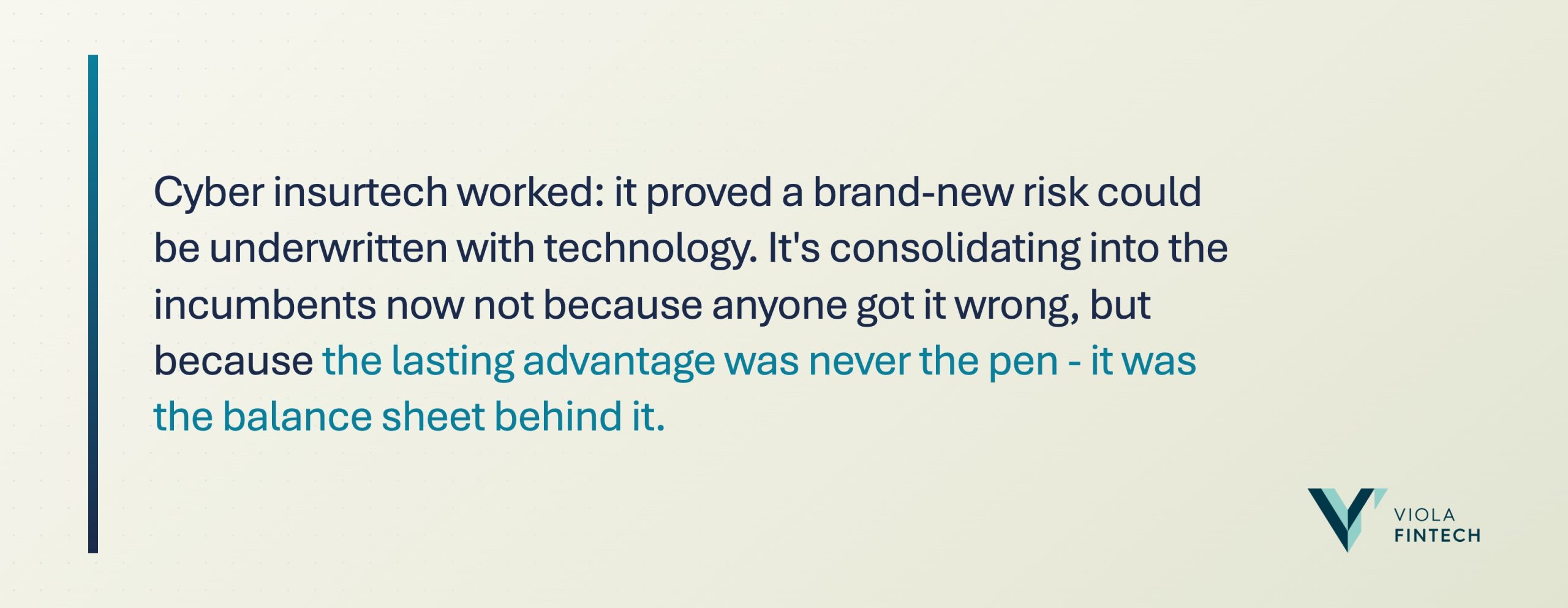
What’s new is that AI changes the math – but the most important change isn’t the one people reach for first. Yes, an AI-enabled roll-up can attack the cost of service delivery, shifting the human agent from being in-the-loop on every quote and renewal to being on-the-loop for the high-value exceptions, and yes, that expands margins in a way a legacy competitor carrying the old cost structure cannot match. But if cutting cost is the goal, you’ve missed the point. The cost savings are a byproduct. The real prize is using that same technology to make the product and the experience meaningfully better – faster answers, proactive advice, fewer errors, genuine advocacy – because a better experience is precisely how you deepen the trust you just acquired. Strip the drudgery out of an agent’s day and you don’t merely save money; you free them to do the high-value, human work that earned the customer’s trust in the first place, now at a scale that was never possible before. An emerging player like Gyde, an AI-native brokerage for health insurance, captures the spirit of it – positioning its technology to elevate what brokers can do for clients rather than simply to replace them. And unlike a direct-to-consumer insurtech burning capital to manufacture a customer relationship from scratch, the roll-up inherits distribution and trust that already exist, at entry multiples of roughly one-half to two times revenue. Automate the cost, and spend the dividend on trust.
We find this compelling precisely because it sits at the very top of the Value Stack: you are buying ownership of the customer and their trust – the two scarce assets – and applying technology to the layers beneath. But it is not a free lunch, and the history here demands humility. Roughly two-thirds of roll-ups have historically failed to create value; projected cost synergies routinely fail to materialize; and the local goodwill that made these agencies worth buying can evaporate the moment a corporate brand strips the relationship out of them. The winners won’t be the funds that simply buy agencies and bolt on a chatbot. They’ll be AI-native operators for whom automation is the operating model from day one – and who are disciplined enough to protect the very trust they are paying for.
From Cyber to AI: A Category Matures, Another Opens
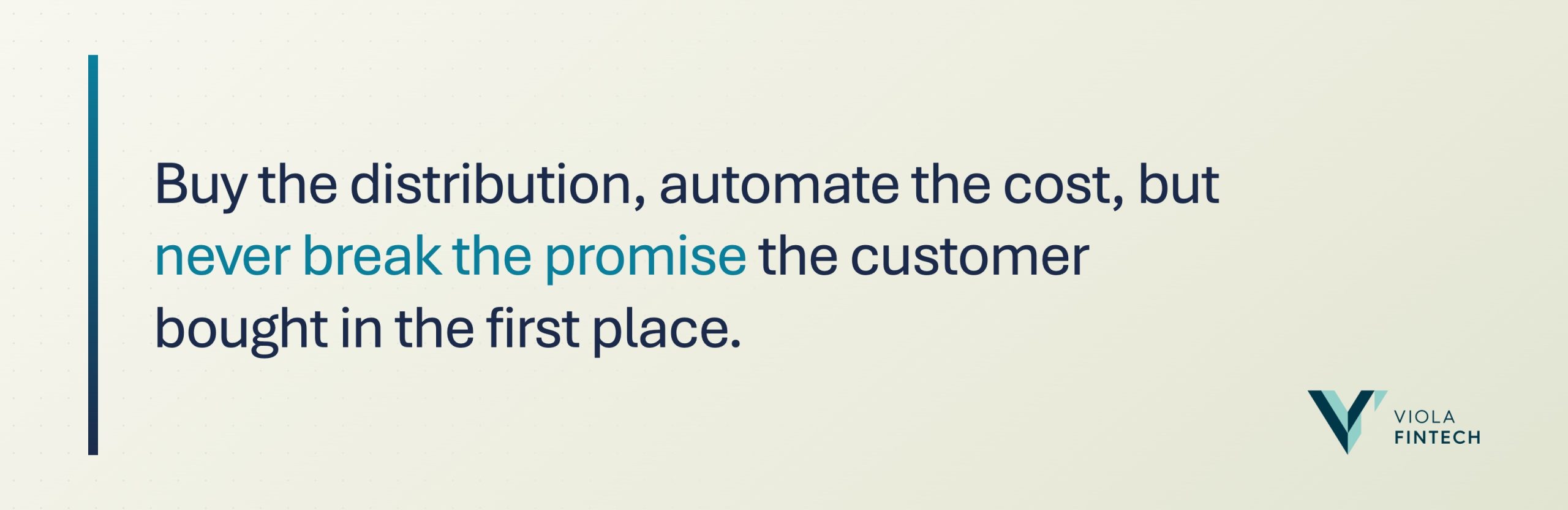
For a live view of the thesis, look at cyber, and specifically at the capital layer. It started out as the perfect opportunity for tech startups – new risk, surging demand, sleepy incumbents. Today, it is no longer a lucrative category for new entrants. The reasons map exactly onto the stack: startups rented their capital and are now watching carriers pull that capacity; the risk is systemically correlated, so a single widespread vulnerability can hit an entire book at once; the underwriting edge is being replicated by the carriers themselves; and because cyber is broker-sold, the startup often owns neither the capital nor the customer. It’s the death-zone squeeze in a single line of business. We’ve backed two companies in this space –
Cowbell and Baobab – and the lesson is instructive. Pricing cyber risk was never the hard part; ownership was. The reinvention, we believe, is to stop building an insurer that dabbles in security and start building a security company that happens to carry risk – one that leads with continuous protection, monitoring, and prevention, owns the customer relationship every day rather than once a year at renewal, and earns trust long before a claim is ever filed. Baobab is a compelling illustration of what that model can look like: protection-, security-, and monitoring-first, with the insurance as the wrapper rather than the starting point. What’s interesting is less any single product than the assets that approach quietly accumulates – a live, continuous view of how businesses are actually exposed, and a relationship of trust that sits upstream of the policy.
In a world where AI is about to reshape the entire risk landscape, and where whole new categories of exposure are emerging faster than the market can price them, that vantage point is precisely what positions a company to underwrite the risks that barely exist yet. The edge won’t come from a better model for yesterday’s threats; it will come from being close enough to the customer to see tomorrow’s first – and being ready to move when they do. AI Liability is essentially the new Cyber – a brand-new risk the incumbents can’t price yet, and requires deep tech expertise. And just like cyber ten years ago, that’s exactly where the next insurtech gets built and where the underwriting edge is not commoditized yet.
Insurance Becomes Invisible – Except Where Trust Is the Product
Play this forward, and the shape of the future comes into focus. Most personal-lines insurance stops being a standalone purchase and dissolves into the products and platforms people already use – invisible, embedded, on-time. The standalone insurance brand survives only where trust is the product: in cyber, in life, in catastrophe, in the moments that genuinely frighten people. And the next generation of category winners won’t describe themselves as insurance companies at all. They’ll be distribution and infrastructure companies that happen to carry risk. For those of us deploying capital behind this shift, it comes down to a single question we now ask every founder: who owns this customer, and why do they trust you?
If the answer is “we buy them, and we’re a little cheaper,” we pass.
If the answer is “we’re embedded where they already are,” or “we own the rails everyone runs on,” or “we’re the name they believe when it matters most” – that’s where the next decade of insurance value is going to be built.
